Psychosocial factors are also important. Positive emotions, the ability to regulate emotions, cognitive flexibility, possession of a moral compass, social support, training, rapid recovery and understanding the purpose and meaning of the mission are all factors that lessen the chances of a soldier developing PTSD, Dr. Southwick explained. And having a mentor with these attributes can also be important. “Resilient role models can transmit attitudes, values, and patterns of thought and behavior,” he noted. “Imitation is a very powerful way of learning.”It sounds remarkably similar to good parenting. There are some notions among some that to be a good military NCO is to be the cold, emotionless (except for explosive bouts of anger) drill sergeant type, the SGT Rock type. There is a time when the NCO needs to put his foot up someplace in a swift military manner. And there are those few who respond only to such treatment, but they are a much lower number than many who subsribe to such types of treatment would tell you. I've been fortunate to have the love and respect of the men that I've lead. I don't see it so much as me leading them so much as I have to give my best to a group of great men.
Saturday, January 31, 2009
Chemical changes in the brain
This story has some interesting things that are starting to come out more and more. Further down in the story is the role of mentorship. I cannot stress this one thing enough, the role of NCO's to mentor their troops with all the tools listed...


Wednesday, January 28, 2009
relationships
Relationships, if they are good ones, make us happy. Some of us might want to be stodgy old bugbears and not admit that we want a relationship of sorts, whether with friends or a spouse/partner, or so on. But we do. Relationships make us happier and, being with people who know us, allows us a fuller means of expressing ourselves and testing our strengths.
Relationships, for the veteran and partner, can be a bit tricky. Chances are there are some changes after a deployment, uncertainty, miscommunication, fear, and a changing of identities. I've heard an equal mixture of interest and scoffing at an announced weekend retreat for soldiers and their wives to 'learn marriage skills'. Besides, there isn't a lot of language offered to us in dealing with relationships, emotions, and how to tie it all together without coming across as a granola eating, hippy, touchy feely kinda guy. Add to this our normal inclination to shy away from the murky waters of our emotional landscape (where the lanscape is a minefield) because men don't talk about feelings.
At a later date I want to put chapter 14 on this blog in its entirety. Not now, because I wish to sleep and I need permission to do so. But it uses an ingenious example of our relationship with our rifle. Below is a video of the Marine Rifleman's Creed. Every marine knows this, but every one who's served knows their weapon they were trained on. We must know a rifle's strengths and weaknesses as well as our own body's strengths and weaknesses in relation to the weapon. We must care for it. We must train with it. We must not try to make it something it isn't but see it for what it is. When it is dirty and muddy and we are tired and beat and want to sleep, we must put in the work and clean it and maintain it. For if the rifle goes down, we go down
Learn to see your partner for who that person is. If your perception has changed, adjust your 'dope' (your sight alignment/picture adjustments on the rifle). Put in the work to patch things up. I'll put the chapter up at a later time, it is really good. But if you cannot wait, you can order the book (it is worth it) here.
The Marine Rifleman's Creed
This is my rifle... there are many like it but this one is mine...
happy to be home ... but I miss the action
As strange as it seems, inside there's a need to get back to the war. I can't tell my folks this because they'll think I'm not glad to be home. I feel trappd, and like someone who is schizo or something. I'm glad to be back, but there's something always gnawing at me and I can't figure it out... I feel really confused.
-An OIF Veteran
I've heard many of the guys I was over in Iraq with tell me this same thing. Some have sought out other deployments to go on, volunteering with other units, contracting services, anything to get back to a place where life was real again.
In Iraq things were real and they were simple. You do your job. There wasn't a lot of grey. Back home in the civilain world things are not so simple. The entire world is grey. You also pulled your share of the weight, watched each other's backs, and developed strong bonds. Back home there is uncertainty. Some, not wanting to confront the great amguity of life in the safe and lax civilian world feel a need for some thrill. If they cannot redeploy they might seek thrills, ride motorcycles or vehicles in a dangerous manner, or pick up dangerous and other risky behaviors. There is a need to maintain an adrenaline 'high'.
And there is also guild in being in a safe place while our brothers and sisters are still in a war. We have a guilt in feeling what right have I to take it easy while others are out on patrol right now, risking their lives?
wired for life
Before I deployed down range I was different around my wife and kids. Now that I'm back I can only let them get so close before I have to get away. I used to have fun letting my boys jump and crawl all over me. We would spend hours playing like that... Now I can only take a couple of minutes of this before I have to get out. I usually get in my truck and drive back to base to be with my platoon...
A young sergeant paratrooper with 173 Airborne Brigade
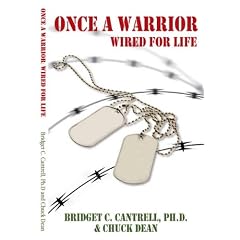
Page 33 of "Once a Warrior: Wired for Life" by Cantrell and Dean
The young sergeant referred to here in the book was confused. He loved the energy of his kids before Iraq but after deploying, but now the high energy of his kids sent him over the edge. In Iraq he was 'wired tight' and was able to keep cool, to predict, endure, had greater tolerance levels... and when he came home he found that he was easily knocked off balance. He felt like a failure and he was afraid of the person he had become.
In this chapter, Chuck, a Vietnam vet, tells of his own emotional distancing when he got back from Vietnam. In the military we use the term 'the wire' to refer to the perimeter. It is a powerful symbol for us. For computer programers another symbol of protection and security might be a firewall, for others... a shield. We had our 'wire'.
Inside the wire we could let our guard down a little bit, though not really because there is always the incoming mortar attack. What can you do when mortars hit? How many times have I heard someone say "no use running... you might run to where they are landing". Many of us simply resolved to let the mortars 'fall where they may'. When my platoon, which operated on FOB Volunteer (the Old Iraqi Olympic Stadium a few blocks from Sadr City) would visit a large major base and happenstance occurs that the base is mortared, we'd shrug our shoulders and sit in our humveess while everyone around ran for bunkers during mortar attacks.
One time, as I was in the motor pool checking on a broken rig, my squad of three guys, had driven to the small chow hall to pick up a food delivery for some soldiers that lived at an Iraqi Army post. They moved their rig from one spot to another. Then a mortar attack and one of the mortars came close to where they had just been parked. This was proof positive for everyone that you can't plan to go anywhere, just go where you go and let the cards fall where they may.
However, outside the wire is a different story. Outside the wire one is on guard all the time. Even if you are on patrol and have to hole up for a while and you want to get sleep, you leave lots of wakeful eyes with fingers on triggers to keep watch. Outside the wire you are all business. Inside the wire, not so much.
Whenever I had guard duty at the front gate I would sometimes walk outside the front gate. I was alone, the rest of the guards were inside the gate and talking about women or football or whatever. I would go outside the front gate and lean against the wall. The night would be quiet and I'd reflect on the noticeable change in my nature with just a few steps. Subtle, but different.
This chapter in the book suggests that our new wire is a mental one. We've seen some pretty fucked up shit. How do you cope? You make a wall. You make a wire. Inside you are okay, outside is the threat. The building of this wire is normal. It has different forms. I trained as an EMT and a firefighter and came into contact with Emergency Room doctors and nurses and paramedics and firefighters who daily saw heartbreaking ordeals. To cope they developed a dark humor, making jests and poking fun of things that others not in their line of work would consider morbid or disrespectful. The people who did these jobs were very respectful of human life, but they needed means of coping with the loss around them. We too have seen destroyed bodies and homes. We've seen what is left of a busy intersection when a carbomb goes off. We've seen the result of our own shots. We too must cope, and so we build our 'wire'.
A new theory of dreams
I am not a sleep specialist, but I do know that getting enough sleep is a very important part to healing the mind from traumatic experiences. I would speculate that we have inherent qualities within us, a natural resiliency and 'human' tendencies (interpret as you wish) that, if given REM sleep can test out the damaged schemas of the non-REM sleep, discarding them over a period of time until we cull the maladaptive schemas.
Interesting video.
Major General Smedley D. Butler
Boys with a normal viewpoint were taken from the fields and offices and factories and classrooms and put into the ranks. There they were remolded; they were made over; they were made to 'about face', to regard murder as the order of the day. They were put shoulder to shoulder, and through mass psychology they were entirely changed. We used them for a couple of years and trained them to think nothing at all of killing or of being killed. Then suddenly, we dishcharged them and told them to make another 'about face'. This tiem they had to do their own readjusting without mass psychology, without officers' aid and advice, withou nation-wide propaganda. We didn't need them anymore. So we scattered them about without any speeches or parades. Many, too many, of these find young boys are eventually destroyed mentally, because they could not make that final 'about face' alone."
(written between WWI and WWII...)
Smedley D. Butler,
Major General, USMC
1936
Two-time winner, Congressional Medal of Honor
Tuesday, January 27, 2009
Monday, January 26, 2009
From 2000 to 2006, 1,066 male veterans in Oregon took their lives.
I am tired and sleepy and have spent a couple of hours roaming through various books on vets issues and am trying to wrap my mind around things in order to pull some of my weight at work on this research project. At the end of this bout I am about to shut down and go to bed. Before I do I scan the headlines of some news feeds. One of them gets my attention and I read the first paragraph and it brings me to tears.
Retired Oregon National Guard Major Tom Egan died of exposure in Eugene, homeless, with a liquor bottle by his side. Yet he had friends, including members of the National Guard.
Another story listed a statistic that I knew was high but still shocks me whenever I see it.
From 2000 to 2006, 1,066 male veterans in Oregon took their lives. There have been as many Iraq-Afghanistan veteran suicides in Oregon as Oregonians have been killed in theater. Do the math, in 72 months that is almost four suicides per week for six years!
I am not doing enough. I waste too much time. I weep for my lost brothers in arms. I've let them down. Whether they died from their own hands or they froze to death... I let them down.
I am sorry.
Retired Oregon National Guard Major Tom Egan died of exposure in Eugene, homeless, with a liquor bottle by his side. Yet he had friends, including members of the National Guard.
Another story listed a statistic that I knew was high but still shocks me whenever I see it.
From 2000 to 2006, 1,066 male veterans in Oregon took their lives. There have been as many Iraq-Afghanistan veteran suicides in Oregon as Oregonians have been killed in theater. Do the math, in 72 months that is almost four suicides per week for six years!
I am not doing enough. I waste too much time. I weep for my lost brothers in arms. I've let them down. Whether they died from their own hands or they froze to death... I let them down.
I am sorry.
Birth of a Soul
On page 110 of Edward Tick's book War and the Soul is a powerful testimony from a Marine Vietnam veteran.
I laid my gun across my legs and, while the Vietnamese family stared at me without daring to move, I stared out the door of their hut.
That doorway was like a picture frame on the world... like I was staring out trough God's eyes. The men I fought with, the "good guys, yelled like idiots and pushed these little people around. I watched my buddies walk over to the hut right across from me... and torch it. I looked at the family cowering in fear by my side. I looked across the way at my friend, the good guy, and another terrified mamasan... the flames destroy[ing] her home.
Something woke up in me. God and evil. Honor and dishon0r. Right and wrong. These had been automatic concepts... but at that moment.... they were real, living things. You earned them by torturing yourself with questions until you really knew what was right and good and honorable, not because someone told you, but because you saw.
I watched my buddies burn another hut... they weren't gooks, for God's sak!.. They were a helpless mother and her terrified little children! After six months in the bush I saw them for the first time... they weren't evil. They weren't the enemies. They weren't the bad guys. We were!
Everything was turned around. I wanted to raise my M-16 and blast away at these crazy marauding Americans who were wasting this helpless village. Now I had a soul, and I wanted to blast away at these crazy marauding Americans who were wasting this helpless village. Now I had soul, and I wanted to save it an these people by doing the right thing and defending them, even if i cost me my life.
I just walked off in a stupor while they... torched the hut. My hut with my family in it. Where I found my soul. Where I figured out the truth. I was in a daze for a long time. Then I went numb for the rest of my tour.
At the very moment I found my soul, at the very moment it woke up and I could see the truth for the first time in my life, at that very second when I knew we were evil, it fled, I lost it.
Sunday, January 25, 2009
John Stewart Mill Quote
"War is an ugly thing, but not the ugliest of things. The decayed and degraded state of moral and patriotic feelings, which thinks that nothing is worth war, is much worse. The person who has nothing for which he is willing to fight, nothing, which is more important than his own personal safety, is a miserable creature and has no chance of being free unless made and kept so by the exertions of better men than him."
-- John Stewart Mill (1806-1873)
Introduction video from Eddie on PTSD
video 1 part 1. Eddie talks about joining the military
Video 1 part 2. Eddie talks briefly about being new in Iraq.
Video 1 part 3. Eddie briefly talks about ramificatios of PTSD on returning troops.
Subscribe to:
Posts (Atom)


 Posts
Posts


